It is important to check your home environment regularly to make sure it is safe for you and your partner especially as PD symptoms progress. Be open to new arrangements and remember, change can be challenging, so take it slow.

There was a question at a recent support group meeting, “now that we know my partner has Parkinson’s, do we need to sell our two-story house?” We went around the circle sharing thoughts and came to the conclusion that we can’t answer that question. Some of us have been able to modify our current homes so they would meet the needs of our partners, others have had to make bigger changes that even include assisted living arrangements. These decisions will depend on how the disease presents itself in each individual and how their symptoms progress. There may also be other factors that normal aging brings into the game for either of you. The key is to be open to the fact that there will have to be some changes and then figure out how to make those happen.

My husband and I were lucky in that we already lived in a single-story home when he was diagnosed. As his physical challenges progress, we think about making life easier for both of us, starting with the layout of the house. It’s pretty basic, we don’t put big pieces of furniture in the way. New purchases are tested out in the store before we bring them home, which can be interesting as we roll around on mattresses and practice getting in and out of chairs. The things we use more often are kept in easily accessible locations, our top shelves are getting emptier and emptier. We shower rather try to climb in and out of a bathtub.

I think the most important thing we do is to talk honestly about what is working and what isn’t. If we do need to make changes, we discuss them before they happen, surprises around the house really aren’t a great idea anymore. Planning smart takes only a few moments but can be lifesaving for us both as we age.

For more on creating a safe home environment, click here to download the Davis Phinney Foundation’s Home Safety Checklist.


Find a group of people who are on a similar journey to yours and share the challenges. Open your heart as you learn to laugh and cry together building a positive network of support.

It had never occurred to me that joining our local Parkinson’s support groups would give me as much benefit, if not more, than my husband. Being around people who have PD and those who love and care for them has given me a totally new perspective on our journey. The Parkinson’s community is so much bigger than we thought when my husband was first diagnosed and, while everyone has a different story, I find so many similarities with my fellow CarePartners.

Through the PD support group I found other people who knew what I was talking about when I spoke about earthquakes in bed in the middle of the night thanks to his tremors. They got it when I talked about good versus bad days and the frustrations of medications and meal schedules that didn’t always work. They too worried about the potential for cognitive changes and wondered how to deal with what was coming. This was a safe place where I could share my stories and be understood by others who were also seeing changes in their loved ones. As we compared notes, I realized I had found a home.

I have since branched out to help form a breakfast group and coordinate local education opportunities for CarePartners. Socializing together promotes a stronger of community as we open up about the challenges we face each day and find ways to share a laugh. Life is too short (with or without PD) and no one should ever face it alone. Support is available for all of us, reach out and find it today.

Laughter lightens any load.

I have heard it said that “Laughter is the best medicine” and I guess it is true, but there are times when I just don’t feel like it. However, those are the times when I especially need to find a chuckle because nothing lightens my CarePartner’s load more than laughing at the absurdity of it all.

Parkinson’s Disease is like a dark cloud that is always on our horizon and we never know for sure when the storm will hit. Instead of waiting for a downpour, I am learning to create my own sunbreaks. This may sound too simplistic, but when things are at their most stressful, if I look to my husband and we share a laugh, it will all go a little better. And, isn’t a little bit better all we can hope for sometimes?

There are many reasons to find excuses to laugh everyday. A good laugh soothes nerves and releases tension while massaging and stimulating your internal organs. A belly laugh works your core muscles and strengthens your diaphragm. It doesn’t really matter if it is genuine or forced, the benefits are still there.

So, the next time you are feeling frustrated, stressed or ready to give up, picture my friend here and throw your hands into the air with a hearty “hee haw”.  Trust me, it will change your mood and get you started on a better day.

For more information on the healthy benefits of laughter check out this page on the Mayo Clinic website- “Stress Relief from Laughter”.

Finding moments to breathe, check in with yourself, and be grateful can help keep life in perspective and keep you on a positive track. Schedule them into your day until they become a habit.

My moment comes every morning while drinking my second cup of coffee. This is the time when I check in with the world, look at emails and my other social media accounts, but the most important thing that I do is to check in with myself through journaling. It is amazing how just taking a few minutes to jot down often random thoughts can clear my mind and let me prepare for the day. I imagine my brain as a pressure cooker and journaling is the release valve that allows me to vent the excess steam before moving forward into whatever today might bring.

We have set up boundaries around this time that work well for both of us. We placed a desk in a spare bedroom so that I am close should he need me, yet he knows that when I am in my space I want to be left alone unless it is really important.  I write in the mornings which allows him the time to get through his daily tasks without me there watching, pressuring him to hurry up, or trying to help. He can still do most of these things alone and I need to stay out of his way and let him.

You will never, or seldom, find the same thoughts written here that are in my journal. My husband reads my blog, he doesn’t have access to my other writings. Just as he needs his time and space, so do I, and the journal is a safe place where I can say whatever I need and know that it will never go anywhere else. Venting hurtful thoughts and words before they explode out of my mouth helps me maintain and move forward to have a more positive day.

It isn’t often that I can say anything positive regarding my husband’s diagnosis of Parkinson’s Disease, yet it did finally force me to start writing. The words were always there, the release wasn’t. Chronicling the challenges I face on my journey as his partner, and sharing them with my husband has helped us communicate better and makes us a stronger team as we continue his battle with PD.

Journaling is my “coping skill”, for more information about coping with the challenges we all face as partners, check out this article Coping Skills for Care Partners on the Parkinson’s Foundation website.

Start everyday by looking in the mirror and giving yourself a smile. Kindness must start within and then it will spread and impact everything you do.

Being gentle with yourself is key to being gentle with the ones you love and the world around you. I know that it is not right for me to use unkind words or become frustrated with my husband. And yet, if I make a mistake, I immediately jump into negative thoughts about myself without even realizing it. I may do something “that is so stupid” or “thoughtless” and wonder why “I can’t get it right!”. As a matter of fact, my self-talk often includes comments I would never say to another person, so why is it okay to say them to me?

I need to learn to look at myself with kindness and understanding and know that I will bring my best self to everything I do. Life as a CarePartner can be difficult and I am only human. No matter how hard I try, there will always be things that don’t work quite the way I hope they will and it is okay. Failure is a vital component of success and I need to allow myself to experience it without recrimination and keep on trying.

I am working to see beyond my challenges to look at the inner strength and skills I do possess that carry me forward through every day. And, I will remember to look in that mirror every morning and smile.

Keeping and sharing accurate information is essential when caring for a loved one with a chronic illness. Don’t depend on doctor’s offices to keep track of everything, instead accept the role of recordkeeper for his care team to make sure everyone is on the same track.

Isn’t it interesting that in this time of electronic medical files, the professionals working with my husband still don’t seem to be able to share information in a timely and useful manner?

We started keeping a notebook that houses all of his medical information and appointments. All of his doctor’s business cards are in the front followed by a listing of his current diagnosis, medications and schedule. Then there are different sections for his various medical concerns. For example, he has one section for his appointments with his neurologist and another for his visits with his primary care physician. There is a section for the surgeon who operated on his shoulder and another for the physical therapist he sees. I know that all of this information is accessible on-line but not all of the doctors share files. By keeping all of the after-visit summaries in one place, we make sure the information is always available. All we have to do is grab the binder and head to the appointment.

We include copies of legal documents such as his POLST form, his Medical Advance Directive, and the Power of Attorney that allows me to make medical decisions for him. It is challenging enough to know I might have to make difficult decisions without having to try to find the correct document in the moment. Again, it is all in the binder ready for any emergency.

This image has an empty alt attribute; its file name is med-binder.jpg

Now if I just had a binder for myself …

Relationships are about connections. Remember to take the time to connect with people on every level if you truly want to build a network of friends and support.

One challenge that I face is having time for personal relationships without taking away from caring for my partner. I need to find ways to be with people who know me as a person because they remind me that there is a world away from our lives with Parkinson’s. And so, I work at building stronger relationships and keeping things going. It may be meeting a friend for happy hour or another for lunch, people who know me for reasons other than my husband’s diagnosis. The friendship and support they can offer helps me remember who I am and it is vital for me to find time for them.

While it is great to maintain connections with friends from the “outside” world, I also need people around me who understand and share in our journey. These are the people who can laugh with me at the absurdity of some of the situations I find myself in, and yet be ready to share an encouraging word or a hug when things get tough. I definitely want to know people who get it, whatever it might be on any particular day when living with someone with Parkinson’s.

Opening up to others is not easy for me and yet it has been essential in my journey. Isolation can be as devastating to the CarePartner as it is to the person with Parkinson’s, I know because for the first few years after his diagnosis, I was living it. I was still working and many had social interactions but few on a meaningful level. When I was finally able to start reaching out to others around me, it was like coming home. My personal connections are now what keep me sane and I am thankful everyday for all my friends and the support we share.

Especially on those days when you feel rushed, take a moment to breathe and refresh your thoughts and spirit so you can move forward in a more positive and relaxed way.

Frustration often comes when I am trying to get something done in a hurry. If I can just slow down and catch my breath, think about what I am trying to do, and then act, it always goes much better.

One thing that my husband says about his diagnosis is “the hurrier I go, the behinder I get”. He understands that PD slows down all of his movements and if he tries to fight against that, it simply becomes more difficult. The same holds true for me when I am trying to help him. If I push or rush him, he gets flustered and I get frustrated. Instead, we need to remember to allow adequate time for tasks and take our time to do them right.

I told someone once that I thought I was put on this earth to learn patience and it has been a challenging lesson. Whenever I begin to feel frustrated with my husband because things are not moving as quickly or in the way I want them to, I need to stop and remember that he is the one with the disease and he is doing the best he can. I need to take a breath and remember that his is the real battle, I can only support from the sidelines and do it with love and patience.

Being active is the most important key to improving your mood and feeling better overall. Getting up and doing something everyday, whether it is with or without your partner, will help protect your physical and mental health.

The older I get and the further we go on our PD journey, the more important it is for me to be active. I try to find things that make me move with purpose every day. That means stretching, walking, yes exercising, to keep my brain and body healthy so that I can be ready to provide the support and help my partner will need.

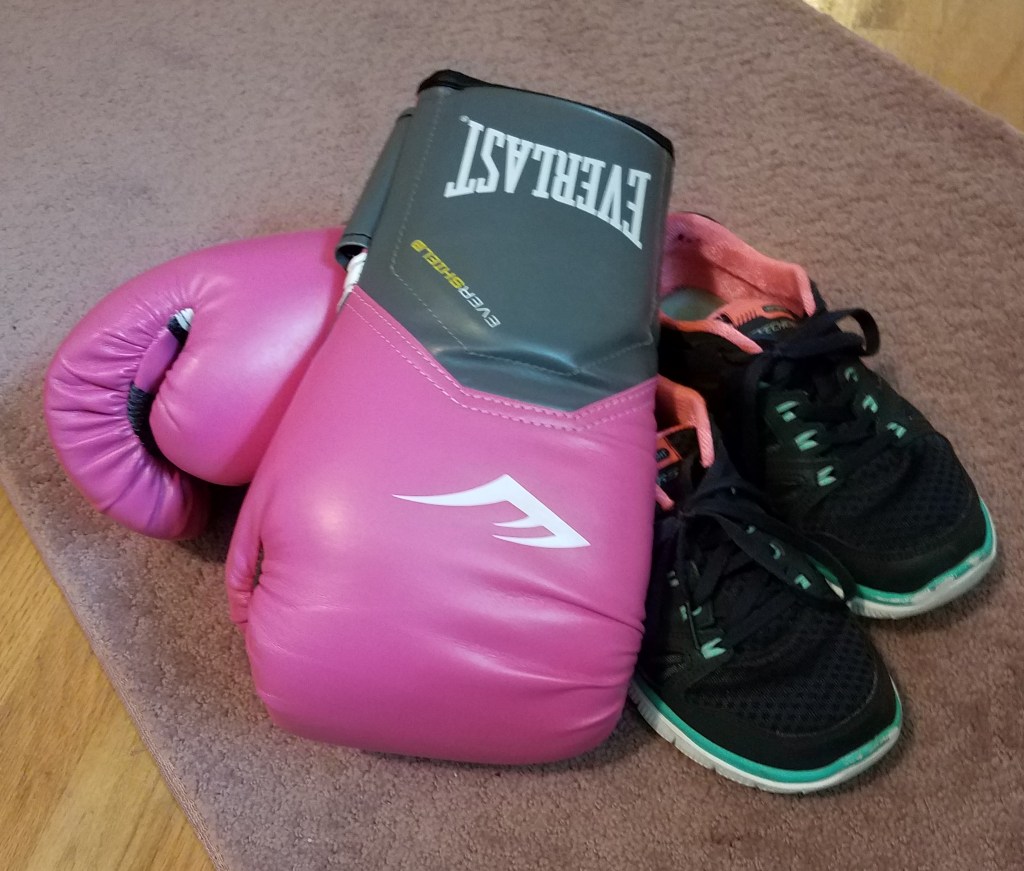
There are many reasons to stay active as we age. They range from the basics like increasing blood and oxygen flow to the brain in support of your mental processes to building a strong body and healthy immune system to keep illness away. Since I started participating in Rock Steady Boxing with my partner 2 years ago, I have not had a cold or flu bug. I may have muscle aches and pains from the workouts, but those pass, and I am feeling stronger every day.

Whether it is joining a gym or just taking a walk around the neighborhood, give yourself the gift of movement. You, and your body, will be happy you did.

My positive thought for today is Breathe. When everything seems to be overwhelming you, take a moment, close your eyes, and take a deep gentle breath. This kindness to yourself allows you to put life back into perspective and take your next step.

I once worked as the billing and collections manager for a dental office. While most of the time, it was great, there were those days every month when I had call patients whose accounts were in arrears and ask for payment. They were the calls no one wants to get and could be painful for the patients and for me. Our office manager taught me the best trick ever and I still use it to this day. She taught me that between each call I should take a moment, close my eyes and take a deep, gentle breath to clear my mind and let go of negative energy. Then she proceeded to surround my workspace with little signs that said “Beathe”. It worked.

There are times when I hear unkind words coming out of my mouth and wish that I had followed this simple advice. Parkinson’s Disease is frustrating, for the person who has it and for the people around them. I see changes happening to the one I love and I can’t stop them. There are times when I realize that life for us has changed and it is not for the better, no matter how hard I try to put a positive spin on it all. When those difficult moments hit me, if I can just take the time to catch my breath and refocus my thoughts, I can respond in a much more productive and healthy way for both of us.